How You.bot’s Gemini Omni Video API Powers Developer Video Generation at Lower Cost
Bringing AI Video Generation Within Reach for Developers
Building video generation into a product used to mean juggling multiple vendor accounts, unpredictable billing, and opaque rate limits. You.bot solves this by hosting Google’s Gemini Omni Video model behind a single, developer-friendly API endpoint that supports commercial use out of the box. Developers get one integration point instead of stitching together separate authentication flows, quota systems, and pricing tiers across providers.
The platform is built specifically with API-first workflows in mind, meaning every model, including Gemini Omni Video, ships with clear documentation, predictable credit-based billing, and a real-time status monitor. This removes the guesswork that typically slows down integration timelines, letting engineering teams move from prototype to production without renegotiating access or re-architecting billing logic mid-project.
Why Gemini Omni Video Matters for Modern Applications
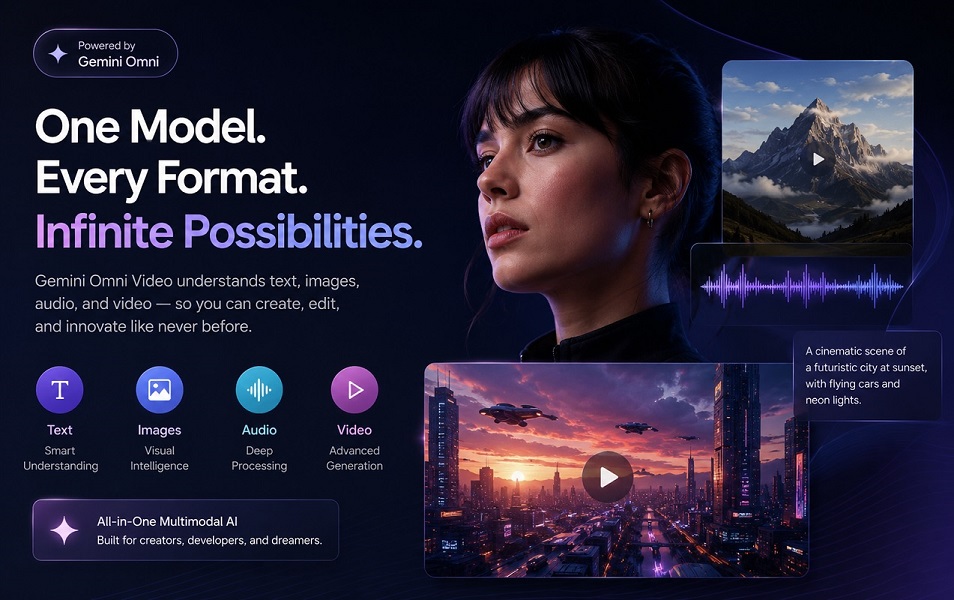
Gemini Omni Video, developed by Google, is a high-quality AI video generation model that supports multiple aspect ratios and durations, from short 4-second clips to longer 10-second sequences. It also supports both text-to-video and video-to-video workflows, giving developers flexibility depending on whether they’re generating fresh content or transforming existing footage.
This versatility matters because video is increasingly a core feature request across SaaS products, marketing tools, and content platforms. Teams building anything from automated ad creation to personalized video messaging need a model that scales across resolutions like 720P, 1080P, and 4K without forcing them to manage separate pipelines for each output quality tier.
Interactive Playground Simplifies Testing Before Production
One of the more practical advantages for developers is the interactive playground, which lets teams test prompts, resolutions, and durations before writing a single line of production code. Instead of burning API credits on trial-and-error integration, developers can validate output quality, timing, and formatting requirements directly in the browser first.
This kind of sandbox environment shortens the feedback loop considerably. A developer can experiment with a 720P 4-second clip, compare it against a 4K 6-second version, and decide which configuration fits their use case, all before committing to a production API call. That iterative testing process is especially valuable for teams working with limited budgets or tight deployment timelines.
Up to 64% Cost Savings Changes the Economics of Video APIs
Cost has historically been the biggest barrier to adopting AI video generation at scale, and this is where the platform’s pricing model stands out. Developers accessing the full API service and interactive playground can see savings of up to 64% compared to standard direct pricing, depending on the specific model and modality selected. For example, a 4-second 4K generation without video input runs at $0.73 per generation on the platform, compared to a standard direct price of $1.8667, a base saving of roughly 61% that climbs to 64% with a credit top-up bonus applied.
These aren’t marginal discounts. For teams generating hundreds or thousands of video clips monthly, a saving in that range translates directly into extended runway or the ability to reinvest saved budget into other parts of the product. Lower per-generation costs also make it financially viable to experiment more freely during development, rather than treating every API call as a precious, tightly rationed resource.
Credit-Based Billing Removes Pricing Guesswork
Rather than negotiating custom contracts or dealing with tiered subscription plans, the platform uses a simple credit system where 1 credit equals $0.01 USD. Every model output, whether it’s a 720P 4-second clip at 31 credits or a 4K 10-second generation at 104 credits, is priced transparently and listed upfront, so developers know exact costs before triggering a generation.
This transparency extends to failure handling as well. If a generation task fails or returns no usable result, the credits spent on that attempt are automatically refunded rather than silently lost. Combined with the fact that credits never expire, this creates a billing environment where developers can top up once and draw down credits at their own pace without worrying about wasted spend or forced renewal cycles.
Top-Up Bonuses Stack Additional Savings for High-Volume Teams
For developers planning heavier usage, a $1,250 top-up pack includes a 10% bonus in credits, which pushes savings even further below direct market rates. On the 4-second 4K generation example, the standard $1.8667 direct price effectively drops to a 64% discount once the top-up bonus is factored in, compared to a 61% base saving without it.
This tiered incentive structure rewards teams that commit to larger usage volumes upfront, which tends to align naturally with production-stage applications rather than early prototyping. A startup scaling a video feature across thousands of monthly active users, for instance, benefits disproportionately from the bonus credit structure compared to a solo developer testing a handful of generations.
Multiple Resolution and Duration Options Support Diverse Use Cases
Flexibility in output specifications is another core strength of the API. Developers can choose between 720P, 1080P, and 4K resolutions, and durations ranging from 4 seconds up to 10 seconds, depending on the requirements of their specific application. A social media tool might prioritize shorter, lower-resolution clips optimized for fast loading, while a marketing agency producing polished client deliverables might lean toward 4K outputs despite the higher per-generation cost.
This granularity means teams aren’t forced into a one-size-fits-all pricing or quality tier. Instead, they can mix and match specifications across different parts of their product, using cheaper, faster generations for internal previews and reserving premium 4K outputs for final, customer-facing content, all through the same unified API.
Status Monitoring Builds Reliability into the Developer Workflow
Beyond pricing and flexibility, operational reliability plays a major role in whether developers trust an API for production use. The platform includes a 24-hour status monitor showing real-time operational health, giving developers visibility into uptime trends and average generation costs, such as roughly 31 credits per run for baseline configurations.
Having this kind of transparency baked directly into the model’s documentation page means developers don’t need to rely on third-party status pages or community reports to gauge reliability. It’s a small detail, but one that matters significantly for teams building time-sensitive features where video generation delays could directly impact end-user experience or downstream automation pipelines.
Expanding Beyond Video into Character and Audio Generation
Gemini Omni’s capabilities extend beyond standard video generation to include specialized outputs like Gemini Omni Character and Gemini Omni Audio, priced separately at approximately $0.0963 and $0.0321 per generation respectively. These lower-cost, specialized generations open up use cases like character-driven content or audio-only outputs without requiring developers to run a full video generation pipeline.
For developers building layered media experiences, such as a video with a distinct character element or synchronized audio track, having these specialized endpoints available under the same API umbrella reduces integration complexity. It also means smaller, cheaper generations can be tested and iterated on independently before being combined into a full video production workflow.
Positioning Within a Broader Ecosystem of Video Models
You.bot doesn’t limit developers to a single model option. The platform also hosts alternatives like Veo 3.1 and its faster variant for rapid iteration, Kling 3.0 for cinematic multi-shot output, PixVerse V6 for stylized high-motion content, Grok Imagine, and Wan 2.7 Video. This gives developers room to compare performance, pricing, and output style across providers without leaving the same billing and API infrastructure.
Having this range of models accessible through one platform matters for teams that don’t want to lock themselves into a single vendor’s roadmap. If a project’s requirements shift, from cinematic storytelling to fast stylized clips, developers can pivot model choice without renegotiating contracts or rebuilding their integration from scratch, keeping development cycles fast and adaptable.
Practical Considerations before Integration
Before integrating any video generation model into production, developers should map their expected volume against the credit pricing table to estimate monthly spend accurately. Since costs vary meaningfully by resolution and duration, for example, jumping from 720P to 4K roughly doubles or triples the per-generation credit cost, this upfront planning step prevents budget surprises once a feature scales beyond initial testing.
It’s also worth testing multiple duration and resolution combinations in the playground first, since output quality and generation cost don’t always scale linearly. A team optimizing for cost efficiency might find that a 6-second 1080P clip meets their needs just as well as a longer or higher-resolution alternative, while saving meaningfully on a per-generation basis across thousands of monthly calls.